
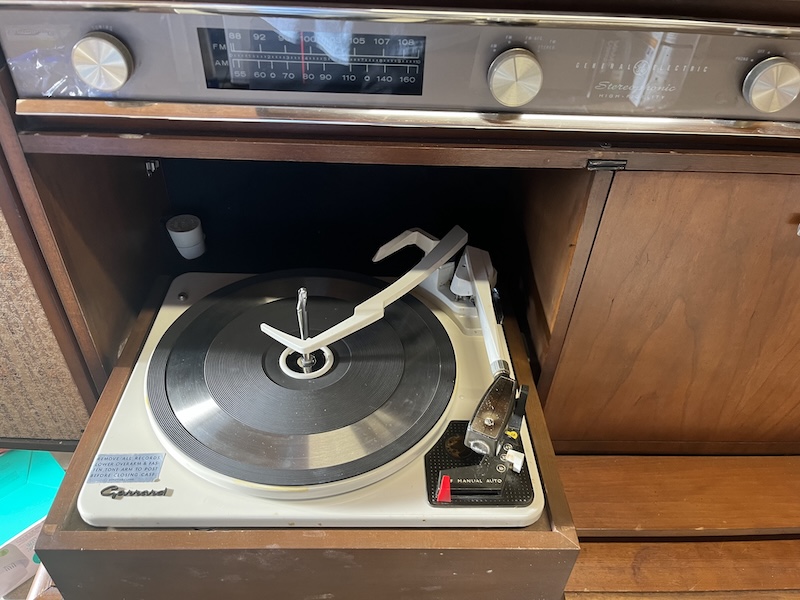
General Electric RC-1674a

Discussions of all brands of consoles not listed above, tube and solid state, stereo and mono.
Post Reply
User avatar
halzg
Junior Member
Posts: 6
Joined: Mon Oct 05, 2026 1:26 am
Location: Brighton Michigan
Contact:

General Electric RC-1674a

Post: # 30728Post halzg »

Hello, I have inherited a GE RC-1674a mini console. This is the type that can be wall-hung, although this one never was. It was the main stereo in my childhood home, and has been stored in my father's (damp) basement for the past 25 years, unused. I've been checking it over and researching it for a few weeks, and here is what I've learned so far:

The unit powers on and plays. I had not read the warnings about old electrolytic capacitors, but now that I have, I will not apply power to it any more until I have the filter caps in a better state.

The Garrard changer appears to be an Autoslim-P model. It was sluggish but functional when I first brought it home, so I removed the changer and cleaned / lubed the pivots and bearings, and did a mild resurface on the drive wheel, and now it works as it should.

The amp works, it has a light 60 cycle hum. All the inputs work, including the RCA plugs for the tape input. The pots were all scratchy, but have cleaned up with some de-oxit.

Both speakers work and sound decent for their age.

The tuner works but is very difficult to tune and drifts badly. The FM-ATC and FM-Stereo circuits both work. The tuner has a more pronounced 60 cycle hum than the amp alone.

I have the Sams Photofact Set 674 Folder 9, which is for this unit.
IMG_2913.jpeg
IMG_2914.jpeg
Attachments
IMG_2915.jpeg
User avatar
halzg
Junior Member
Posts: 6
Joined: Mon Oct 05, 2026 1:26 am
Location: Brighton Michigan
Contact:

Re: General Electric RC-1674a

Post: # 30732Post halzg »

Here are a few photos of the inside. I've read the advice that the entire electronic assembly should be removed as one, due to the indiviual chassis being hardwired together. I'd appreciate any insight as to how to access the chassis mounting screws for the tuner. It appears to be screwed to the underside of the cabinet top, and the dial is screwed to the cabinet front. There is one screw hidden behind the tuner flywheel, looking in from the back. I'm not sure how to access that.

The amp board shows some darkening around the tube sockets. The board is also flexible enough to make me nervous about breaking traces while removing and installing tubes.

I'm fairly acquanited with tube amps, due to experience with guitar amps. Tuners, however, are a mystery to me.

I've noticed a few other members here either have the same console, or a console with a different cabinet but the same electronics inside.
IMG_2919.jpeg
IMG_2918.jpeg
IMG_2921.jpeg
User avatar
halzg
Junior Member
Posts: 6
Joined: Mon Oct 05, 2026 1:26 am
Location: Brighton Michigan
Contact:

Re: General Electric RC-1674a

Post: # 30733Post halzg »

As it turns out, the screws that look like they secure the tuner dial to the faceplate are adjustable standoffs, so I removed two screws holding the tuner chassis to the top of the cabinet and the whole thing slid back. This after I (unnecessarily) removed a few cabinet screws and took the faceplate off. :? d

Overall the tuner looks good visually. I'll post photos tomorrow and continue working to get the electronics out.
User avatar
electra225
Site Admin
Posts: 8981
Joined: Thu Jul 08, 2021 7:48 pm
Location: San Tan Valley, AZ
Contact:

Re: General Electric RC-1674a

Post: # 30735Post electra225 »

I have a set of those guts upstairs that I took out of an ugly GE console. IT works, pretty well, actually. That amp is found in several GE stereo/record players. I have that amp chassis in an RC-1590 C and I use it more than almost any other stereo record player I own. The amp chassis has a power transformer and single-ended 7189 audio output. Basically souped-up 6BQ5's that are made to run on higher plate voltage than a 6BQ5. I've used 6BQ5's in my GE stereo just to see what would happen. I didn't see any difference. You might want to test or sub tubes in the tuner and make sure the antenna is adequate for your location. Those tuners are not known to drift. They have AFC and built-in stereo decoder, so they were ahead of their time. The amp chassis boards tend to burn around the output tubes and rectifier sockets. This can be remedied if necessary by hard-wiring the PCB with bell wire. I redid one like that in 2014 and it still is going strong. The biggest issue with those chassis is the tone board. They suffer from broken or damaged trace(s) that are nearly impossible to find. The cure is to hardwire the entire board. IF you need to clean the controls, they have to be removed from the board if a "simple spritz" doesn't help. GE made very simple electronics, made to a price point, but are really pretty tough and reliable. They perform above their pay grade.
Life can be tough. It can be even tougher if you're stupid.....
User avatar
William
Global Moderator
Posts: 5424
Joined: Fri Jul 09, 2021 12:42 pm
Location: Hart, Michigan
Contact:

Re: General Electric RC-1674a

Post: # 30736Post William »

That big orange electrolytic capacitor that is beside the amp chassis is the first thing you need to replace. Like you, I fired up the one I was servicing for someone just to see what worked. Like you it fired up and played just fine, I did not have any sign of a hum which usually indicates the filter cap is bad. I turned my back for a couple of minutes and when I turned around the rectifier tube was bright red and the PT was so hot you could fry an egg on it. The PT survived but the rectifier tube did not. Be sure to add a fuse as you do your servicing. It will help prevent components from getting fried in case a capacitor shorts out.

Also, if you take a look at your cartridge I bet it will be a GE100, that is what was in the one I serviced and is in a GE portable I have.

Thanks for sharing the photos, we love photos. :)

Bill
User avatar
halzg
Junior Member
Posts: 6
Joined: Mon Oct 05, 2026 1:26 am
Location: Brighton Michigan
Contact:

Re: General Electric RC-1674a

Post: # 30741Post halzg »

Thanks all for your help and for following along. Here's the state of affairs today:
IMG_2929.jpeg
IMG_2930.jpeg
IMG_2931.jpeg
IMG_2932.jpeg


The electronics are on the bench, visually everything looks okay, nothing is visibly burned or damaged. My next step is to get some electrolytics to replace the cardboard filter cap. Is it coincidence that it looks like a huge firecracker?

I've read that the selenium rectifier on the tuner board should also be assumed bad (besides the electrolytic caps on the tuner). Is that the consensus here?

Also, I do not plan to re-stuff the cardboard filter cap. Since it has long leads, my thought is to clip those close to the cap, then use them to connect to new Electrolytics, which I can mount on a terminal strip at the location where the bracket for the cardboard cap was. I know it won't look original, but are there other concerns with that arrangement?

Thanks to all,
Hal
User avatar
halzg
Junior Member
Posts: 6
Joined: Mon Oct 05, 2026 1:26 am
Location: Brighton Michigan
Contact:

Re: General Electric RC-1674a

Post: # 30742Post halzg »

Here's another photo of the tuner board, that shows the rectifier and the filter cap.
IMG_2928.jpeg
Post Reply

Who is online

Users browsing this forum: No registered users and 27 guests