Page 3 of 4
Re: GE Wellington coffee table, model RC 4842-A
Posted: Fri Nov 14, 2025 4:13 am
by electra225
I have the guts from a GE stereo that had a bad "mystery wood" cabinet. I posted a topic about it on the forum. Is there anything shown here that you could use?
https://www.classichificare.com/viewtopic.php?t=3734
Re: GE Wellington coffee table, model RC 4842-A
Posted: Fri Nov 14, 2025 4:44 am
by TC Chris
I haven't been an avid fuse-adder, mostly from lack of ambition, and also because of a debate in my mind. Simply stated, is it better to have a fuse on the AC line, or in the B+? The one big "unobtainium" item in most of thee devices is the power transformer. I've always wondered whether a line fuse would protect the transformer in the event of a filter cap failure.
I have a little Knight-kit 6BQ5 amp that was pulled from service when it overheated and started smelling. It's likely a filter cap failure. I haven't done any diagnosis, because I assumed at first that the transformer was destroyed. Now I wonder if it got coked a bit but would still be serviceable. In event, the line fuse didn't protect it.
Chris Campbell
Re: GE Wellington coffee table, model RC 4842-A
Posted: Fri Nov 14, 2025 4:35 pm
by stbasil
Greg, I did see that thread, thankfully my PCB was in great condition compared to that one! Regarding the sound, I'm adding two piezo tweeters to mine, angled upward at 45 degrees, on the front, since the speakers are below the knees! Preliminary test was promising, added a nice brightness which I will tweak later with the crossover. That's a 3" PVC pipe, the tweeter flange fits perfectly into the end!
Chris, for me, the fuse (1 amp) is mainly a safety thing; the bad filter caps apparently didn't harm the PT when the seller plugged it in to test it. I agree that it might not save the PT in a long-term powered on situation with a shorted filter cap, but I don't want to test that to find out!
Re: GE Wellington coffee table, model RC 4842-A
Posted: Fri Nov 14, 2025 4:49 pm
by electra225
I have a Temple radio, circa 1928 that has both the primary of the PT and B+ fused, from the factory. Technically, all the fuse in the primary of the PT will protect is the surroundings of the device, not necessarily the primary of the PT. To truly protect the PT, B+ should be fused. Very few people ever do that. It wouldn't be that tough to do, really. Just put a fuse in right after the cathode of the rectifier and you would be good. Other than the influence of the bean counters, I don't understand why more manufacturers, particularly high end ones, didn't fuse B+ in their devices.
The guts from the stereo I posted about actually works very well. The PCB is in good shape, don't know why it looks so bad in photos.
Re: GE Wellington coffee table, model RC 4842-A
Posted: Thu Nov 20, 2025 7:06 pm
by stbasil
After many days of sanding, I'm pretty much ready for staining with walnut stain. Not sure what kind of wood this actually is...
The changer's rotating enclosure is a walnut finish inside, not maple like its front and the rest of the cabinet, so I'm leaving that as-is with just some cleaning (it has been removed in the photos).
Those panels in the top are veneered inserts, in several areas they weren't flush with the adjacent wood, and sanding went through the veneer in a few small places on the edges. Should be able to blend those in when I stain. I think the factory had to do some heavy sanding when the cabinet was made, so the veneer was already thinner in those places. I always vacillate between sanding vs stripping, but stripping is so incredibly messy --I guess it's less likely to damage veneer, but you still have to sand!
There were a couple of places on the top that were dented, probably by other furniture being placed on it during a move. I thought it would be of interest to show how I addressed that. I read in several places online that you could remove dents by placing a wet paper towel over the dent and applying heat with an iron to force steam into the wood. That expands the crushed wood fibers and raises the dent, and amazingly, it worked pretty well. Before and after photos of one of the dents (prior to sanding), its about 1.5" long. After sanding, that dent was still present, though not as deep, so I steamed it again and after drying and another pass with the sander, it was completely gone!

- Dent before

- Dent after
I'm going to use 100% Tung oil for the final finish. My wife and I refinished an old upright piano (we used stripper on it) and after staining, finished it with Tung oil. That was over 30 years ago, and it still looks great!
Re: GE Wellington coffee table, model RC 4842-A
Posted: Thu Nov 20, 2025 7:44 pm
by electra225
That cabinet is not a typical GE cabinet. Most of the ones I've seen were made from "mystery wood", a combination of Masonite and sawdust. Your cabinet appears to be made of ash. It's kinda hard to tell with it sanded, but that would be my guess. I don't know what GE used for a finish, but, again a guess, I'd bet it was something sprayed on in one pass. With the care you are using on refinishing, it should look fantastic. Properly applied tung oil makes a very attractive finish. "Putting some of yourself" into the project makes it very special when it's done. Great job!......

Re: GE Wellington coffee table, model RC 4842-A
Posted: Thu Nov 20, 2025 10:03 pm
by stbasil
Well, I just realized that I can't put tung oil over an oil stain.

I think that old piano is mahogany and we just stripped it, then put on tung oil. The light wood on this cabinet won't turn out dark enough without staining first, so I'll stain and then finish with laquer or poly, I guess.
Re: GE Wellington coffee table, model RC 4842-A
Posted: Thu Nov 20, 2025 10:30 pm
by electra225
If you decide to use poly, be sure to put a good coat of shellac on to seal the wood and to eliminate the possibility of getting fish eyes. I really like using gloss poly, then wet sand it with 1200 grit or 2000 grit to dull the "plastic shine" the radio snoots get their shorts in a wad over. Poly is nearly indestructible. It will take fire or a D9 dozer to hurt it. Lacquer is not only antique technology, but it can be damaged by almost anything. My Stereo Theater has 18 coats of poly on it. That's a story for another topic.
Magnavox 1ST616 with poly finish...
Re: GE Wellington coffee table, model RC 4842-A
Posted: Thu Nov 20, 2025 11:53 pm
by William
Can you apply tong oil over a water base stain?
Bill
Re: GE Wellington coffee table, model RC 4842-A
Posted: Fri Nov 21, 2025 1:13 am
by electra225
I've only used tung oil once in my life. I used it on a Belmont radio cabinet that I still have. I have no idea if you can use it over water based stains. I'd say that if in doubt, using a wash coat of shellac wouldn't hurt.
Re: GE Wellington coffee table, model RC 4842-A
Posted: Fri Nov 21, 2025 3:05 am
by stbasil
Everything I've read says it's not recommended to apply over stain. That's because tung oil is supposed to penetrate deep into the wood, where it cures to a hard finish, and if it's not raw wood, the stain inhibits that penetration by clogging the wood fibers. I suppose it would be okay to use a wood dye, but I'm not experienced with dyes. I'll probably just stick with stain & poly, "the devil I know"
Re: GE Wellington coffee table, model RC 4842-A
Posted: Fri Jan 16, 2026 5:33 pm
by stbasil
Haven't posted on this project in a while, because the cabinet didn't like being sanded! That exposed some very thin veneer on the top, and some pretty ugly grain elsewhere. I just wasn't happy with the result, even though it looks okay in the photos
So, I'm in the process of veneering the whole thing with mahogany, it's a fun learning experience! I'll post some pictures after I'm a little further along.
Re: GE Wellington coffee table, model RC 4842-A
Posted: Fri Jan 16, 2026 9:34 pm
by stbasil
Veneer is complete! All the ugly stuff is covered with nice mahogany, took several weeks of off and on work. I should have laid out all the necessary pieces on my 2' x 8' veneer sheet first, but that's a consequence of my learning curve. So I didn't have quite enough to cover the front of the rotating changer compartment. But it just so happened that it's original veneer has a really interesting grain, so I'm going to keep that, it has a stained finish in the photo, which I'll hopefully work on to match the color of the rest of the cabinet after it's finished.

- Veneered top, unfinished
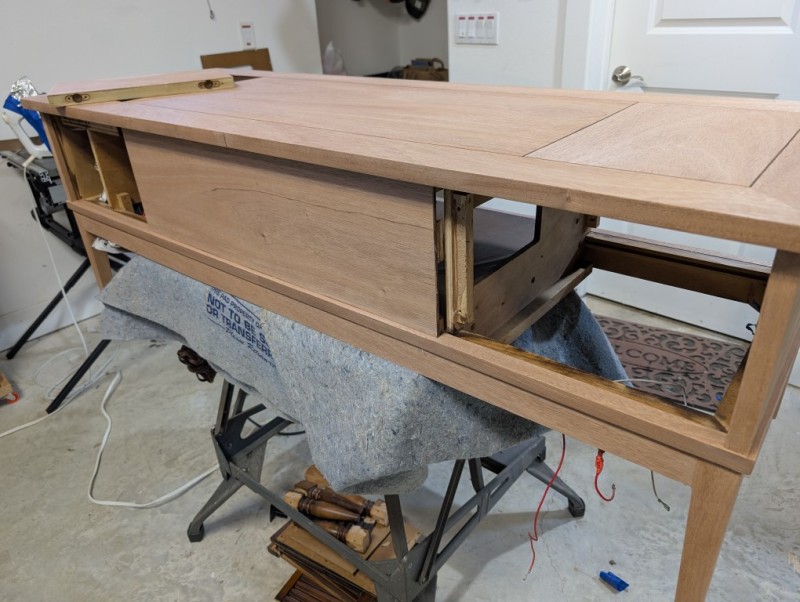
- Veneered back, unfinished
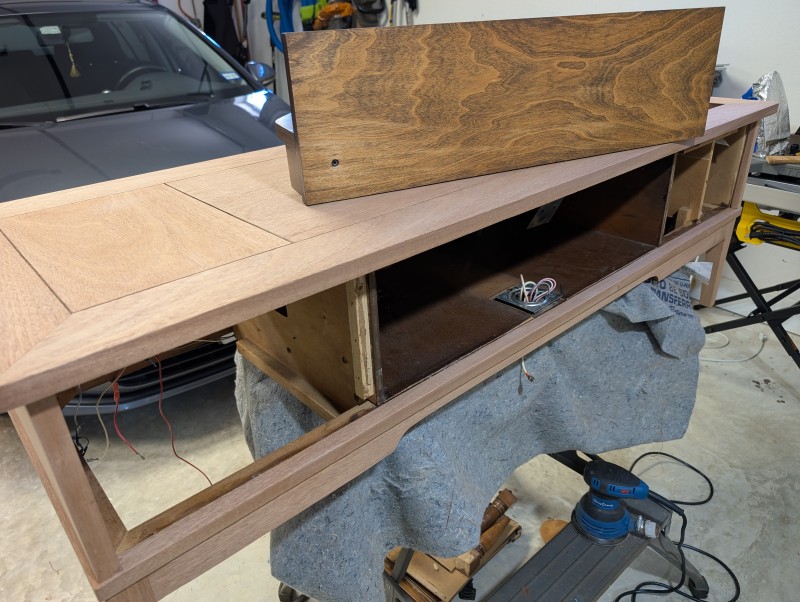
- Veneered front, with non-re-veneered changer enclosure
If I had it to do over again, I would be more selective of the positioning of grain pattern of the center top piece. Of course, that means better planning of the veneer layout prior to cutting--that learning curve again!
I am going to try a chemical stain process instead of oil stain, but I will experiment on some of the scrap veneer first. Also, I just might use 100% Tung oil after all, since that should work well with the non-oii stain; again, I'll experiment first! I prefer a less glossy finish, so no poly or lacquer this time.
Re: GE Wellington coffee table, model RC 4842-A
Posted: Fri Jan 16, 2026 11:15 pm
by electra225
You can get poly in satin and semi-gloss, if that would help. Nice job on the veneer! If you use poly, you might consider a wash coat of shellac. If you decide not to use shellac, and have an adhesion issue, you can sand, seal over the poly with shellac, then apply poly again. I'm not a fan of water based poly, BTW.....

Re: GE Wellington coffee table, model RC 4842-A
Posted: Fri Jan 16, 2026 11:55 pm
by William
Nice job! Is the picture frame hardwood edge on the top the original or did you veneer that too? If it is original you did an excellent job of matching the grain to your new veneer.
Bill
Re: GE Wellington coffee table, model RC 4842-A
Posted: Sat Jan 17, 2026 12:30 am
by TC Chris
What chemical stain process? I use washing soda on mahogany to darken redden it (also works on cherry).
Chris Campbell
Re: GE Wellington coffee table, model RC 4842-A
Posted: Sat Jan 17, 2026 1:54 am
by stbasil
The top is all new mahogany veneer, I really liked the original frame-like design, so I veneered over it and cut the same gaps as the original. The chemical stain I plan to use is potassium dichromate, influenced by this video:
https://www.youtube.com/live/3k7V9tIKg9 ... e0_WC2tact
This veneer is mahogany, but not African mahogany, so it's not as dark as the "real deal". But I'm hoping to get a nice, deep color with the chemical. I also obtained some shellac flakes, I might just finish entirely with that (yes I'm aware of the downsides of that ancient finish!), or Tung oil. I returned some Zinsser shellac that I got from our local Ace when I realized it was pretty old, according to the date code (learned to decipher that in another YouTube video!)
Re: GE Wellington coffee table, model RC 4842-A
Posted: Sun Jan 18, 2026 9:41 pm
by danrclem
It's looking very good.
Re: GE Wellington coffee table, model RC 4842-A
Posted: Mon Jan 19, 2026 5:37 am
by TC Chris
Washing soda is sodium carbonate (I just checked). The video says the potassium compound is toxic. Why don't you get some ashing soda--grocery store item, no shipping charges--and try it on a scrap of your veneer? It's non-toxic (used on your clothes!). If you don't like the result, use the rest of the box as intended--as a laundry fortifier.
On my boats, I use a filler/stain from either Pettit or Interlux. They make it in a few varieties of mahogany--red mahog., Chris-Craft mahog. I can't tel much difference. You can get it from the local West Marine.
I did like that video.
Chris Campbell
Re: GE Wellington coffee table, model RC 4842-A
Posted: Mon Jan 19, 2026 5:49 pm
by stbasil
Thanks, Chris. I already have the potassium dichromate (PD) which was$10 including shipping from Walmart, am experimenting with it, and I will absolutely try the washing soda!
Here's a sample of 3/4" strip of the veneer with single PD application of concentration of 1/2 tsp per 16oz water, after drying. May be a little too dark. Not as pretty as in the video, but then it's not an interesting grain either.